



How to Monitor Social Media Comments and Find Opportunities Your Competitors Miss
Your next customer might already be explaining exactly what they need. The question is whether anyone on your team is paying attention.
Imagine a company that manufactures industrial safety equipment.
Its marketing team publishes product updates, shares technical information, and occasionally runs advertising campaigns. The content reaches engineers, distributors, and purchasing managers, but generating qualified inquiries remains difficult.
Meanwhile, potential buyers are asking questions beneath industry posts:
“Does anyone know a supplier that ships to Brazil?”
“We're looking for an alternative to our current equipment.”
“Is this product suitable for high-temperature environments?”
“What's the difference between these two safety certifications?”
These comments aren't necessarily addressed to the manufacturer. They might appear beneath a competitor's announcement, an industry influencer's video, or a discussion about workplace safety.
Yet they reveal something traditional marketing research often struggles to capture: what buyers are trying to accomplish, in their own words, at the moment the problem matters.
This is where social media comment monitoring becomes valuable.
What Is Social Media Comment Monitoring?
Social media comment monitoring is the process of tracking, reviewing, and analyzing comments across social platforms to identify relevant conversations, questions, feedback, and emerging trends.
It can involve monitoring comments on your own content, public discussions involving competitors, industry creators, or posts related to specific topics.
A useful comment monitoring strategy answers more than “Who mentioned our brand?”
It also helps answer:
What problems are people discussing repeatedly?
Which questions remain unanswered?
What objections prevent buyers from making decisions?
Which products or services are attracting dissatisfaction?
Where could our expertise contribute something genuinely useful?
For a small business, manually reviewing comments may be manageable. For a marketing team monitoring dozens of creators, hundreds of posts, and multiple platforms, the process quickly becomes difficult to maintain.
The objective of automation isn't to read every comment. It's to identify the conversations worth reading.
Why Monitoring Comments Matters More Than Counting Them
A post with 500 comments might appear successful. But what do those comments actually tell you?
Suppose an equipment manufacturer's product video attracts three types of responses.
Some viewers compliment the design. Others ask about price. A smaller group asks whether the equipment meets particular operating requirements.
All three represent engagement, but they don't represent the same business opportunity.
Compliments suggest interest. Pricing questions may indicate purchase consideration. Detailed technical questions can reveal specific evaluation criteria.
The distinction becomes even more important when monitoring conversations outside your own accounts.
A potential buyer might never visit your website or follow your company page. Their first visible expression of demand could be a question posted beneath somebody else's content.
Comment monitoring turns public conversations into a source of market intelligence—not just an engagement metric.
Five Types of Comments Worth Monitoring
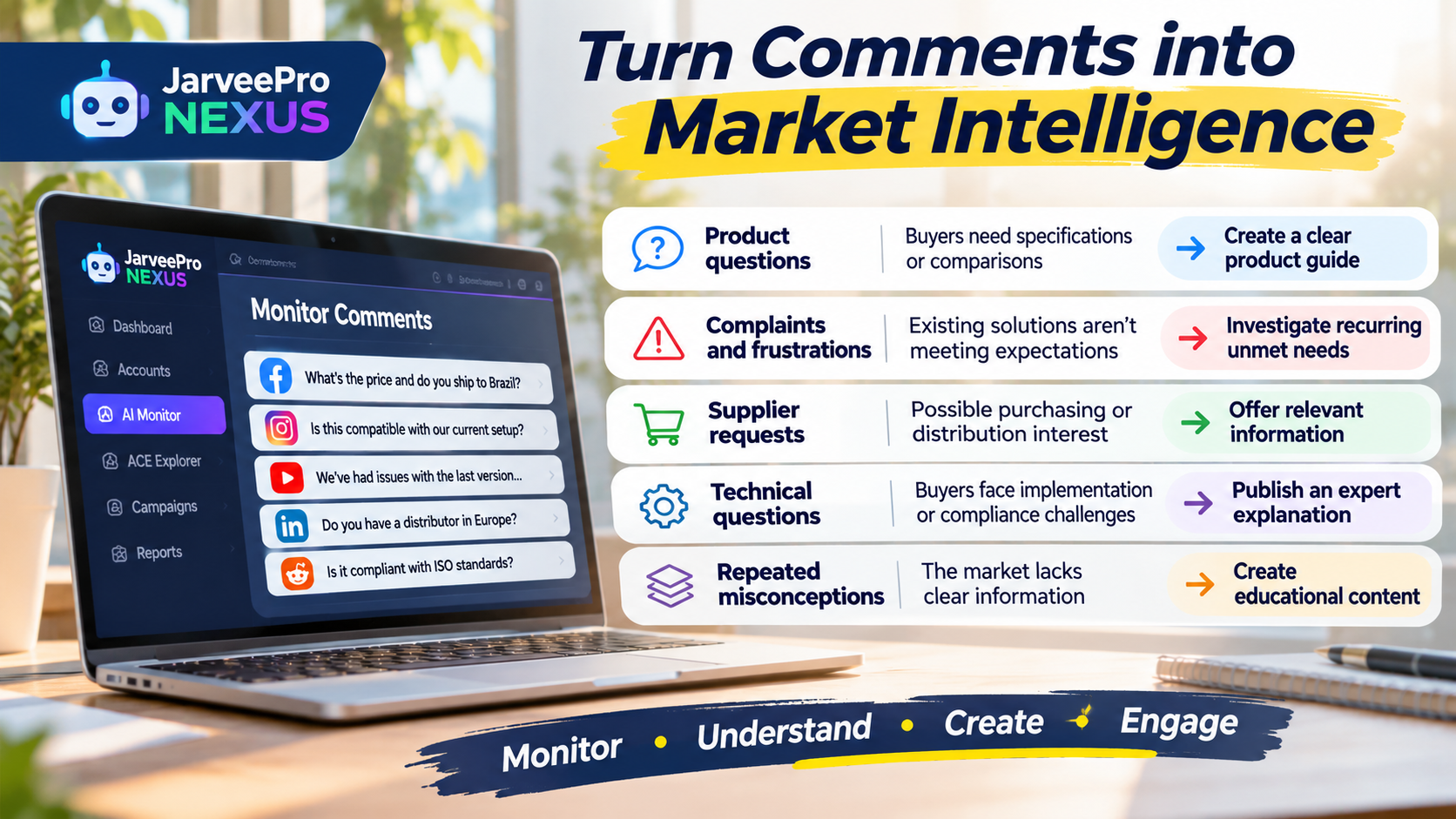
Not every comment represents a qualified lead. Some are casual questions, some lack context, and some are unrelated to your business.
The value comes from recognizing patterns rather than treating every interaction as a sales opportunity.
How to Monitor Comments Across Social Media
1. Start with the conversations that matter to your business
Before choosing a monitoring tool, identify the subjects and accounts most likely to reveal useful information.
For an industrial equipment company, these could include industry associations, technical educators, distributors, competing brands, and creators discussing workplace operations.
For a software company, they might include product reviewers, tutorial creators, relevant communities, and discussions about workflow problems.
Monitoring every popular account is rarely useful. A smaller set of relevant sources usually produces better insights than a large collection of unrelated conversations.
2. Track questions and buying signals, not just brand mentions
Traditional social listening often begins with a brand name.
But people who need your product may not know your brand exists.
Consider the difference between monitoring “Brand X” and monitoring conversations about “how to manage multiple social media accounts.”
The second approach can reveal a much larger set of needs.
Useful monitoring themes include product comparisons, integration difficulties, supplier recommendations, pricing concerns, feature requests, and recurring operational problems.
The goal is to understand demand before it becomes a branded search.
3. Use JarveePro to organize comment monitoring
JarveePro helps teams bring social media research and automation into a more structured workflow.
Its Advanced Content Explorer and AI Monitor capabilities can support discovery and monitoring of relevant public content, including supported comment-related searches and monitoring conditions.
Depending on the platform and configured workflow, teams can work with keywords, selected accounts, posts, and other available search criteria to identify discussions relevant to their business.
Instead of repeatedly checking the same sources manually, a team can organize monitoring around specific research objectives.
For example, an equipment supplier could create separate monitoring workflows for:
Technical questions about product compatibility.
Discussions involving competing suppliers.
Regional demand and distribution questions.
Recurring complaints about equipment performance.
New questions raised by influential industry creators.
The important distinction is that JarveePro helps organize the discovery and execution process; human judgment determines which conversations deserve attention.
Available monitoring actions and search coverage depend on the supported platform and software configuration.
4. Turn comment patterns into better content
This is where comment monitoring becomes more valuable than simply tracking engagement.
Suppose a manufacturer notices that buyers repeatedly ask whether a particular machine can operate safely in humid environments.
That question could become a technical article explaining environmental operating conditions, a short demonstration video, a product comparison, or a distributor FAQ.
One recurring question can reveal several useful content opportunities.
With JarveePro Nexus, teams can use AI-assisted content workflows and scheduling to develop and distribute approved educational material across supported social platforms.
AI can help organize research and prepare drafts. Technical claims, product specifications, and recommendations still need human verification.
The result is a content strategy built around questions people are already asking, rather than assumptions about what they might want to read.
Monitor Competitor Comments Without Copying Competitors
Competitor comment monitoring is often misunderstood.
The goal isn't to imitate another company's posts or approach every dissatisfied commenter with a sales pitch.
It's to learn what the market is telling you.
Imagine a competitor launches a new product and receives substantial engagement. Beneath the announcement, several distributors ask about replacement parts, warranty coverage, and regional support.
Those questions reveal what matters to buyers after the initial product attraction.
Your company could respond strategically by improving its own documentation, making service information easier to find, or creating content that explains the total cost of ownership.
None of that requires copying the competitor.
It requires listening carefully to the questions their audience is asking.
A competitor's comment section can reveal market expectations that never appear in its advertising.
Can AI Monitor Comments and Generate Replies?
AI can assist with comment monitoring by organizing collected information, identifying recurring topics, classifying questions, and drafting potential responses.
For example, a marketing team could use a workflow that discovers relevant posts, reviews available comment information, identifies common questions, and prepares response drafts for approval.
JarveePro's AI-assisted workflows can help connect research, content generation, and supported social media actions.
However, automatic replies need careful rules.
A useful response should address the actual question, respect the context of the discussion, and provide information that the business can substantiate.
A generic promotional comment repeated across unrelated posts rarely builds trust. It may also violate platform rules.
For technical, financial, medical, or safety-related discussions, human review is especially important.
The strongest approach is to automate repetitive discovery and preparation while retaining meaningful editorial control over public responses.
From Comment Monitoring to Qualified Business Opportunities
Let's return to the industrial safety equipment manufacturer.
After monitoring relevant industry discussions, the marketing team notices three recurring concerns: product certification, replacement-part availability, and regional distributor support.
Instead of launching another generic promotional campaign, the team prepares a practical series of resources addressing those concerns.
It publishes an equipment certification guide, a replacement-parts checklist, and a regional distributor information page.
Where appropriate, team members contribute useful answers to relevant public discussions.
Over time, the company can evaluate whether these activities produce better website visits, more technical inquiries, and conversations with potential distributors.
That is a much more meaningful outcome than simply reporting the number of comments collected.
What Should You Measure?
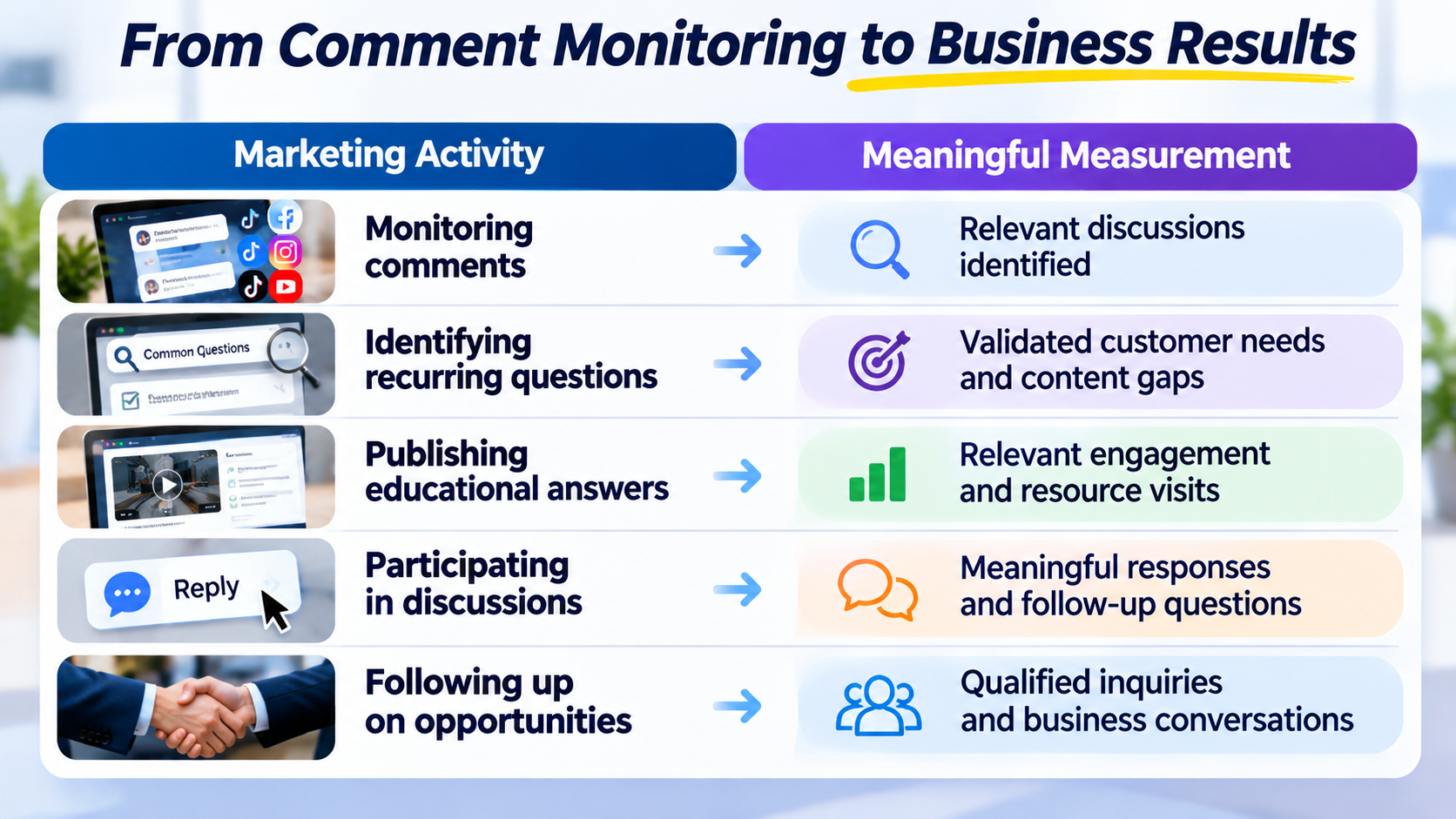
These measurements help connect social media activity to commercial progress.
A comment monitoring workflow should ultimately improve how well a business understands its market, not merely increase the amount of information it collects.
How Often Should You Monitor Comments?
The right frequency depends on the platform, the activity level of the sources being monitored, and the purpose of the campaign.
Fast-moving product launches or active industry discussions may require more frequent reviews. Slower-moving B2B markets may benefit from periodic research and weekly analysis.
For JarveePro monitoring workflows, a conservative starting interval is often around 45–90 minutes where supported, adjusted for the platform, account conditions, and campaign requirements.
There is no universal schedule that guarantees complete coverage or eliminates platform restrictions.
More frequent checks do not automatically produce better intelligence. The priority should be reliable collection, relevant filtering, and consistent review.
The Real Advantage of Monitoring Comments
Businesses spend considerable time trying to predict what their audiences want.
They conduct keyword research, study competitors, analyze website traffic, and experiment with advertising.
Those methods remain important.
But comments add something different: people explaining their questions, frustrations, objections, and priorities in a conversational setting.
When monitored thoughtfully, those discussions can influence product positioning, content planning, customer support, and sales conversations.
JarveePro Nexus can help organize the repetitive parts of that process through supported social media discovery, monitoring, AI-assisted content workflows, and publishing automation.
The larger opportunity is not to automate more comments.
It's to understand more of the conversations that could shape your next business decision.
Explore JarveePro Nexus at jarveepro.com.